
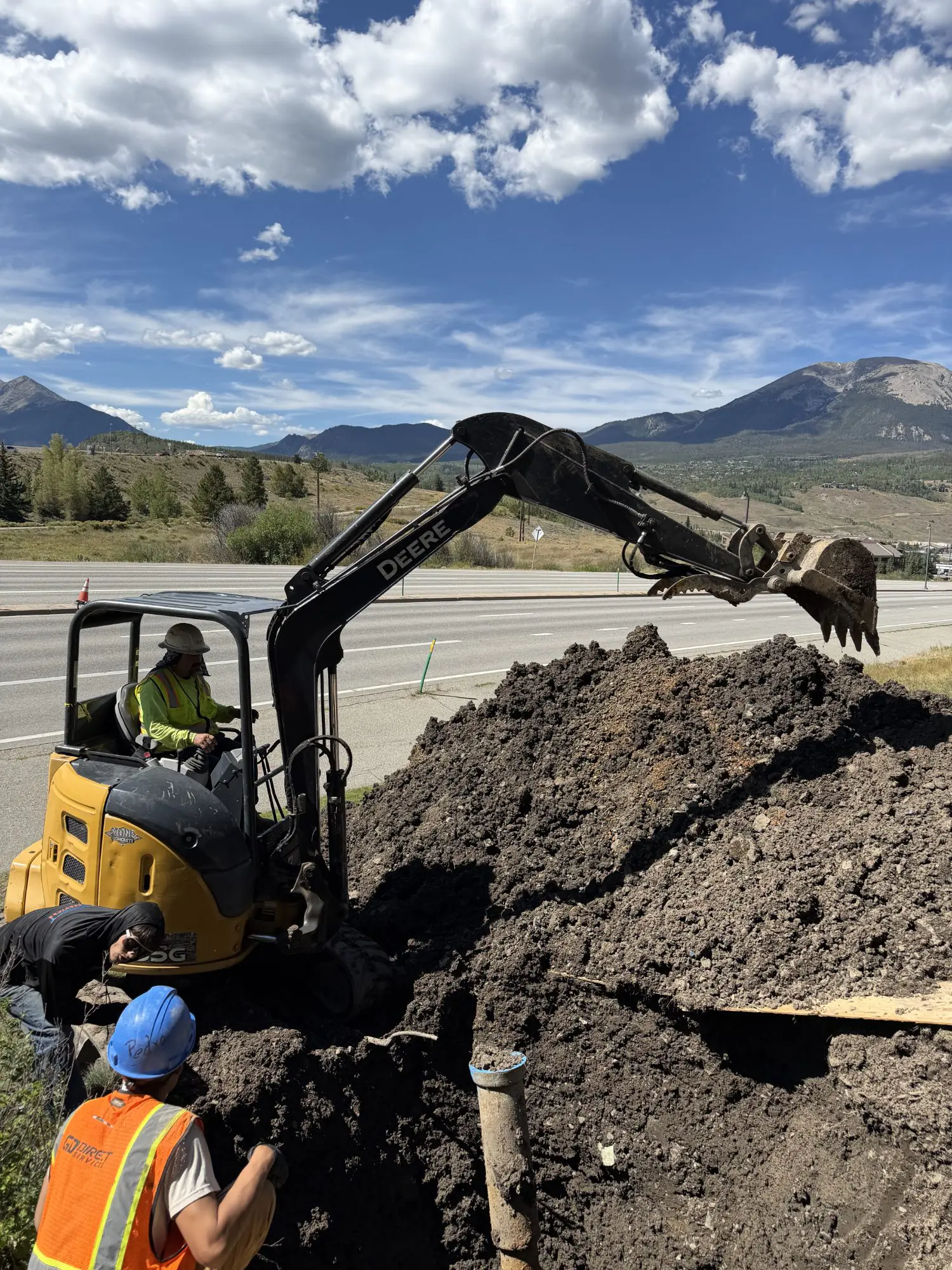
Pipe Bursting (Trenchless Sewer Replacement) in Denver
Pipe bursting in Denver: how trenchless sewer replacement works, when it fits your home, cost vs open trench and our 10-year warranty. Free written estimates.
Pipe bursting replaces your sewer line without digging a trench the full length of your yard. Instead, a new pipe is pulled through the path of the old one, breaking the old pipe apart as it goes. You get a brand-new line with two small pits instead of a torn-up lawn or driveway.
This guide explains how pipe bursting works and when it’s a good fit. It also compares it to open trench replacement and covers what it costs in Denver. We’re Go Direct Services, a family-owned sewer and water line contractor serving the Denver metro.
What is pipe bursting?
Pipe bursting is a trenchless method of sewer line replacement. A cone-shaped bursting head is pulled through the existing pipe. It fractures the old pipe and pushes the pieces into the surrounding soil.
A new pipe, typically high-density polyethylene (HDPE), is attached behind the head. As the head moves forward, the new pipe follows, taking the old pipe’s place. When the pull is done, you have a new, continuous line.
Why HDPE pipe?
HDPE sections are heat-fused into one continuous length, so there are no joints along the run for roots to get into. The material is flexible enough to follow the path of the old line. It doesn’t rust or corrode.
How does pipe bursting work?
- Camera inspection. A sewer camera inspection comes first. We scope the line to confirm it’s a good candidate and measure its length.
- Locates and pits. Utilities are marked, then we dig an entry pit at one end and an exit pit at the other. Usually one is near the house and one is near the tap or main.
- Feed the cable or rods. A pulling cable or steel rods are run through the old pipe from one pit to the other.
- Fuse the new pipe. The new pipe is fused into one length and attached to the bursting head.
- Pull it through. A machine in the exit pit pulls the head through the old line, bursting it and drawing the new pipe into place.
- Connect and close. The new pipe is connected at both ends, inspected where required, and the pits are backfilled.
The yard, driveway or landscaping between the pits stays in place.
Is pipe bursting right for my home?
Pipe bursting works well in many Denver situations. It’s often a strong fit when:
- Your line is clay, Orangeburg or cast iron. These materials break apart cleanly under the bursting head.
- The line runs under a driveway, patio or walkway. Avoiding a trench saves tearing out and replacing concrete.
- Mature trees or landscaping sit over the line. Two pits do far less damage to roots and plantings than a full trench.
- The lot is tight. Narrow side yards and small lots leave little room to pile dirt from a long trench.
- The line has cracks, roots or offsets but still follows a reasonable grade.
When is pipe bursting not the right choice?
Pipe bursting follows the path of the old pipe, including its slope. That means some problems can’t be fixed this way.
- Severe bellies or grade problems. If the line sags badly, the new pipe will sag in the same place. Open trench lets us reset the slope.
- Collapsed sections that need to be dug. If the cable can’t pass a fully collapsed area, that section has to be excavated.
- Many connections along the line. Each branch or fitting needs its own pit, and the trenchless advantage shrinks.
Sometimes the best answer is a mix: bursting for most of the run with an open dig at one problem spot. If only one section is damaged, a sewer spot repair may be all you need.
Want to know if pipe bursting will work for your line? The camera tells us.
Pipe bursting vs open trench: how do they compare?
| Pipe bursting | Open trench replacement | |
|---|---|---|
| Digging | Entry and exit pits | Trench along the full line |
| Yard, driveway and trees | Mostly left in place | Disturbed along the trench |
| New pipe | Fused HDPE, no joints along the run | New pipe laid in the open trench |
| Fixes bellies and grade | Limited; follows the old path | Yes; slope can be reset |
| Typical cost (recent Go Direct jobs) | Varies with length; $9,600 to $22,500 | $9,600 to $17,750 (median $12,400) |
| Warranty | 10 years | 20 years |
Trenchless isn’t automatically cheaper. The savings usually come from not having to replace concrete, landscaping or trees. Learn more about open trench work on our sewer line repair and replacement page.
How much does pipe bursting cost in Denver?
Pipe bursting cost varies with the length of the line. Our recent pipe bursting jobs have run from $9,600 to $22,500.
Your price depends on what the camera shows; every estimate is free and in writing. Line length, depth, pit locations and whether any section needs an open dig all affect the price. For a broader breakdown, see our guide to sewer line replacement cost in Denver.
We offer in-house 0% financing for up to 12 months on qualifying jobs (20% down, no credit check, autopay). Wisetack monthly payments are available for larger jobs, subject to credit approval.
What warranty comes with pipe bursting?
Trenchless sewer replacement by pipe bursting carries a 10-year warranty. For comparison, full open trench replacement carries 20 years and spot repairs carry 3 to 5 years. All of our warranties are transferable to a new owner.
Do you offer pipe lining (CIPP)?
No. Cured-in-place pipe, or CIPP lining, is another trenchless method. A resin-soaked liner is inserted into the old pipe and cured so it hardens into a pipe inside the pipe.
We don’t do lining. We replace the pipe instead. Pipe bursting removes the old line from service and leaves a new, full pipe in its place. If your line can’t be burst, we’ll recommend open trench replacement.
Pipe bursting FAQ
How big are the pits for pipe bursting?
They’re large enough to work in safely and fit the equipment, but far smaller than a full trench. Your estimate shows where each pit will go.
Can pipe bursting go under my driveway?
Yes. Lines under driveways, patios and walkways are among the best fits, because the concrete stays in place.
Does pipe bursting work on Orangeburg pipe?
Often, yes. Orangeburg is a fiber pipe that deforms over time. If the cable can pass through, bursting can replace it. Badly collapsed sections may need to be dug.
Will pipe bursting fix a belly in my sewer line?
Usually not. The new pipe follows the old path, including low spots. Severe bellies are better fixed with open trench replacement.
Is pipe bursting cheaper than digging?
Not always. It can cost more or less than open trench depending on length and site conditions. It often saves money when the alternative means tearing out concrete or landscaping.
What about the tap at the city main?
If the tap has failed, it needs its own excavation. See our guide to sewer tap repair and replacement.
Questions about your line? Call us at 303-288-0039 or book online.
Sewer or Water Line Problem? We Can Be There Today.
Slow drains, backups or a soggy spot in the yard usually point to a sewer or water line problem. Call for a free estimate or book online, with same-day camera inspections across the Denver metro area.