
Sewer Line Replacement Cost in Denver (2026 Guide)
Sewer line replacement cost in Denver, with typical price ranges from recent Go Direct jobs, what moves the price, repair vs. replace, and financing options.
If your sewer is backing up, or the camera found a broken pipe, the first question is usually the same: what will this cost? This guide covers sewer line replacement cost in Denver using real numbers from recent Go Direct jobs. It also explains what pushes a price up or down, and how to tell a fair bid from an inflated one.
We’re a family-owned Denver metro plumbing and underground utility contractor, based in Commerce City. We dig, replace and repair sewer and water lines every week. Here is what we see on real jobs.
How much does sewer line replacement cost in Denver?
On recent Go Direct jobs, a full exterior sewer line replacement has typically run $9,600 to $17,750, with a median of about $12,400. That covers the line from the house out toward the main. Most homeowners land somewhere in that middle range.
The table below shows typical ranges for the work we do most. These figures come from Go Direct jobs completed between June 2025 and October 2026. The range is the middle half of jobs, so some come in lower and some higher.
| Job type | Typical range (recent Go Direct jobs) | Median |
|---|---|---|
| Full exterior sewer line replacement | $9,600 – $17,750 | $12,400 |
| Water line / service replacement | $4,650 – $10,500 | $6,500 |
| Interior / crawlspace sewer repair or replacement | $4,400 – $9,265 | $7,025 |
| Spot repair | $4,560 – $6,500 | $5,199 |
| Pipe bursting (trenchless) | Varies with length; recent jobs $9,600 to $22,500 | — |
| Tap repair at the city main | Street/alley tap work often runs into five figures due to street cuts, traffic control and permits | — |
| Sewer camera inspection | $99 | — |
| Drain cleaning | $280 | — |
| Hydro jetting | About $1,000 | — |
These are typical ranges from recent Go Direct jobs, not quotes. Your price depends on what the camera shows; every estimate is free and in writing.
What makes sewer line replacement cost more or less?
Two homes on the same block can get very different bids. That’s not a trick. The pipe underground is different, and so is the work needed to reach it. These are the factors that move the price most.
Length of the line
More pipe means more digging, more material and more labor. A home set close to the street costs less to reconnect than one set far back on a deep lot.
Depth
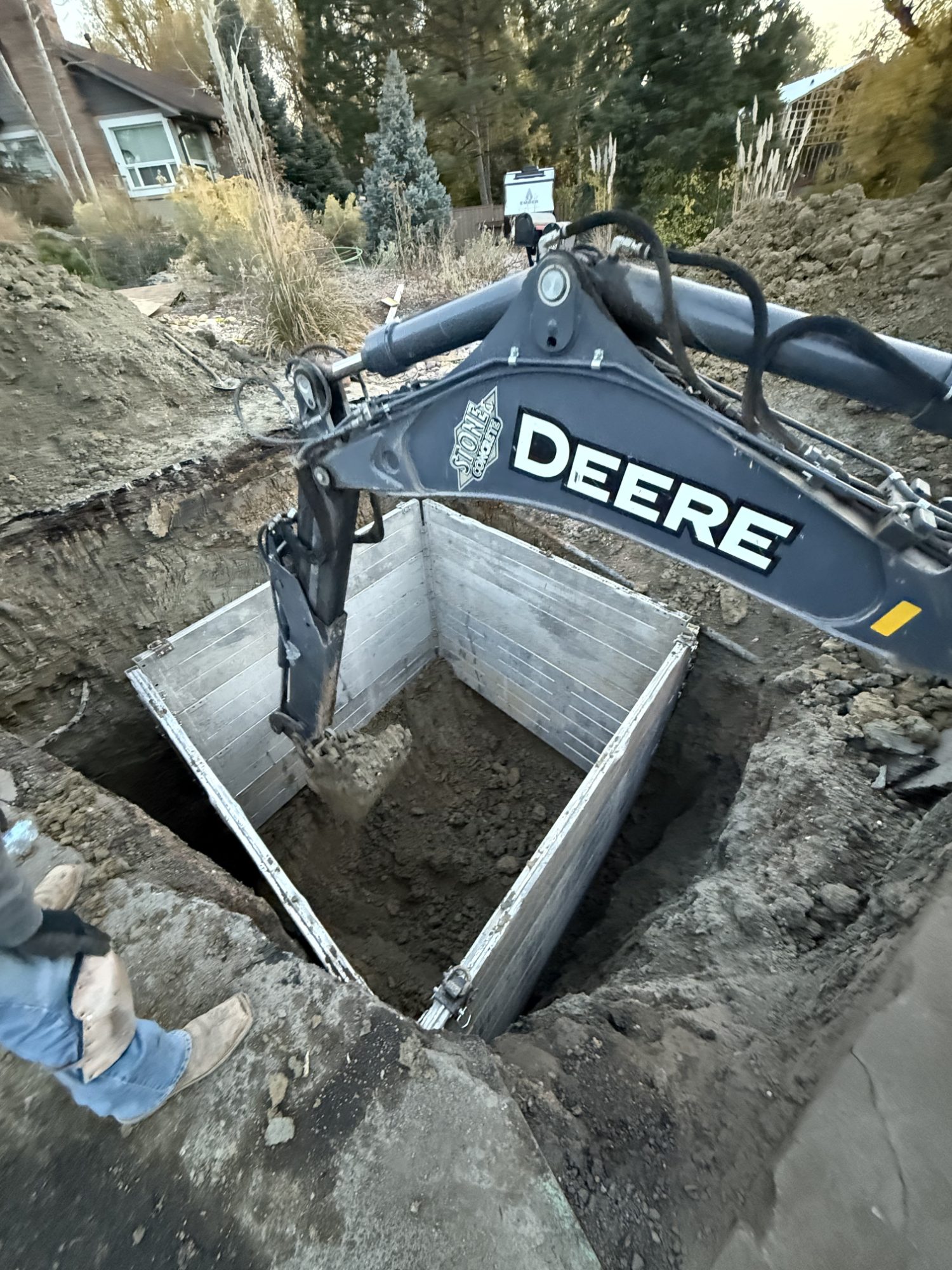
Deeper lines take more excavation and more care. Deep trenches may need shoring to keep the walls from caving in. That adds time and equipment.
Open trench vs. pipe bursting
Open trench means digging along the line. Pipe bursting means digging two small pits and pulling new pipe through the old path. Each has a place, and the right choice depends on the condition and grade of your existing line.
What’s on top of the pipe
A line under grass is the easiest case. A line under a driveway, patio, street or alley means cutting and replacing hard surfaces. That’s often the biggest swing in price.
Tap work at the main
Sometimes the failure is at the tap, where your line connects to the city main. If that main is in the street or alley, the job involves a street cut, traffic control and more permitting. That is why tap repairs often run into five figures.
Permits and street cuts
Sewer and water line work usually needs a permit. Work in the public right-of-way adds more steps and inspections. We include permits in our written estimate so you aren’t surprised later.
Restoration
Once the pipe is in, the ground has to be put back. That can mean backfill and soil, landscape repair, or new concrete or asphalt. Our sister company, Stone & Concrete, handles concrete restoration.
Pipe material
The old pipe matters. Clay pipe cracks and lets roots in at the joints. Orangeburg, a fiber pipe used in some older homes, tends to flatten and collapse. Cast iron rusts and scales from the inside. Badly deteriorated pipe can limit your options.
Access and basement work
If the problem is inside the house, the crew may need to cut the basement slab or work in a tight crawlspace. Interior work has its own price range, shown in the table above.
Should I repair or replace my sewer line?
Not every bad camera report means a full replacement. If the line is mostly sound with one problem area, a spot repair can make sense. If the problems run the length of the pipe, patching one spot just moves you to the next failure.
When a spot repair makes sense
- One break, crack or root entry point, with the rest of the line in fair shape
- A newer line with a single damaged section
- A failure at a known spot, like under a tree that’s since been removed
When full replacement makes sense
- Multiple breaks, offsets or root intrusions along the line
- Orangeburg pipe, or clay or cast iron that is failing in several places
- Bellies (sags) that hold water and waste
- You plan to stay in the home for years and want one fix
How warranties factor in
Warranty length is a good way to compare options. It reflects how long each fix is expected to last. All of our warranties transfer to a new owner if you sell.
| Repair type | Go Direct warranty |
|---|---|
| Full replacement | 20 years |
| Trenchless (pipe bursting) | 10 years |
| Spot repair | 3–5 years |
A spot repair costs less today. But if the rest of the line is old, you may pay again soon. We’ll show you the footage and tell you honestly which way we’d go.
Is pipe bursting cheaper than digging up the yard?
Sometimes, but not always. Pipe bursting avoids a long trench, which can save on restoration when the line runs under a driveway or mature landscaping. But it needs special equipment, and it only works when the existing path is usable. Learn more on our pipe bursting page.
| Open trench replacement | Pipe bursting (trenchless) | |
|---|---|---|
| How it works | Dig along the line, remove old pipe, lay new pipe | Dig two pits, pull new pipe through, breaking the old pipe outward |
| Surface disruption | Trench the full length of the line | Two access pits; much less surface digging |
| Fixes bellies and grade problems | Yes; the new line can be set to proper slope | No; the new pipe follows the old path |
| Best fit | Bellies, collapsed sections, shallow lines under grass | Sound grade, lines under driveways, patios or landscaping |
| Typical cost (recent Go Direct jobs) | $9,600 – $17,750 for full exterior replacement | Varies with length; recent jobs $9,600 to $22,500 |
| Go Direct warranty | 20 years | 10 years |
One note: we do not offer pipe lining (CIPP). Our repairs are open trench, pipe bursting, or targeted spot repairs. See our sewer line repair and replacement services for the full picture.
Find out what your line actually needs before you spend a dollar on repairs.
What’s included in a Go Direct sewer line estimate?
We start with the camera. A sewer camera inspection costs $99 and shows us exactly where and what the problem is. Pricing a sewer job without footage is guessing.
From there, you get a free written estimate. It spells out the scope of work, the repair method, permits, and how the site will be restored. If you’d rather call than book online, reach us at 303-288-0039.
- Camera inspection first so the bid is based on what’s really in the ground
- Written estimate with the scope and method stated clearly
- Permits handled by us
- Restoration of soil, landscape, concrete or asphalt as listed in the scope
- Warranty terms in writing: 20, 10 or 3–5 years depending on the repair
Can I finance a sewer line replacement in Denver?
Yes. A failed sewer line rarely shows up when it’s convenient. We offer two ways to spread out the cost.
- In-house financing: 0% for up to 12 months with 20% down, no credit check, and autopay. Available on qualifying jobs.
- Wisetack: monthly payments for larger jobs, subject to credit approval.
Details are on our sewer repair financing page. Ask about financing when you get your estimate so we can set it up before work starts.
How do I avoid overpaying for sewer line replacement?
Most overpaying comes from not knowing what you’re buying. A few habits protect you.
Get the camera footage
Ask for the actual video, not just a summary. Footage shows the problem and roughly how far down the line it sits. Any contractor can review the same video and bid on it.
Compare scope, not just price
A low bid may skip permits, restoration or the full length of the line. Line up the bids and check that each one covers the same footage, method and cleanup. A cheaper spot repair isn’t a bargain if the line needs full replacement.
Ask about the warranty
Ask how many years the warranty covers and whether it transfers to a new owner. A short or non-transferable warranty is worth less, especially if you might sell.
Ask why that method
If one contractor pushes trenchless and another wants to dig, ask each to explain why. Bellies and grade problems usually need digging. Good bids explain the reason in plain terms.
Is sewer line replacement cost in Denver worth it compared to repeated cleanings?
Regular cleaning can keep a root-prone line flowing for a while. Drain cleaning runs $280 and hydro jetting about $1,000 with us. If you’re paying for cleanings more than once or twice a year, those costs add up fast.
The bigger risk is a backup into the basement. Cleanup and damage repair can cost more than the line itself. When the camera shows breaks, collapse or Orangeburg, cleaning is a short-term patch. Buying or selling? Our sewer repair program for realtors and home buyers covers how this works during a sale.
Frequently asked questions about sewer line replacement cost
How much does it cost to replace a sewer line in Denver?
On recent Go Direct jobs, full exterior sewer line replacement typically ran $9,600 to $17,750, with a median of about $12,400. Your price depends on what the camera shows; every estimate is free and in writing.
Why does my bid include concrete or asphalt work?
If the line runs under a driveway, sidewalk, street or alley, the surface has to be cut and replaced. Restoration is part of the job, and it’s often a big part of the price difference between homes.
Do you offer pipe lining?
No. We repair and replace sewer lines with open trench, pipe bursting, and spot repairs. We’ll tell you which one fits your line based on the camera footage.
Is a spot repair enough?
It can be, when one section has failed and the rest of the line is in fair shape. If the footage shows problems along the length of the pipe, full replacement is usually the better value. Spot repairs carry a 3–5 year warranty, compared to 20 years for full replacement.
Does homeowners insurance cover sewer line replacement?
Many policies don’t cover a line that failed from age, roots or wear. Some offer optional service line coverage. Check your policy and ask your agent before work starts.
Is the warranty transferable if I sell my house?
Yes. Our warranties transfer to a new owner: 20 years on full replacement, 10 years on pipe bursting, and 3–5 years on spot repairs.
Can I make monthly payments?
Yes. We offer in-house 0% financing for up to 12 months with 20% down and no credit check on qualifying jobs. For larger jobs, Wisetack offers monthly payments, subject to credit approval.
How do I get an exact price?
Start with a $99 camera inspection. We’ll review the footage with you and provide a free written estimate. Book online or call 303-288-0039.
Sewer or Water Line Problem? We Can Be There Today.
Slow drains, backups or a soggy spot in the yard usually point to a sewer or water line problem. Call for a free estimate or book online, with same-day camera inspections across the Denver metro area.