
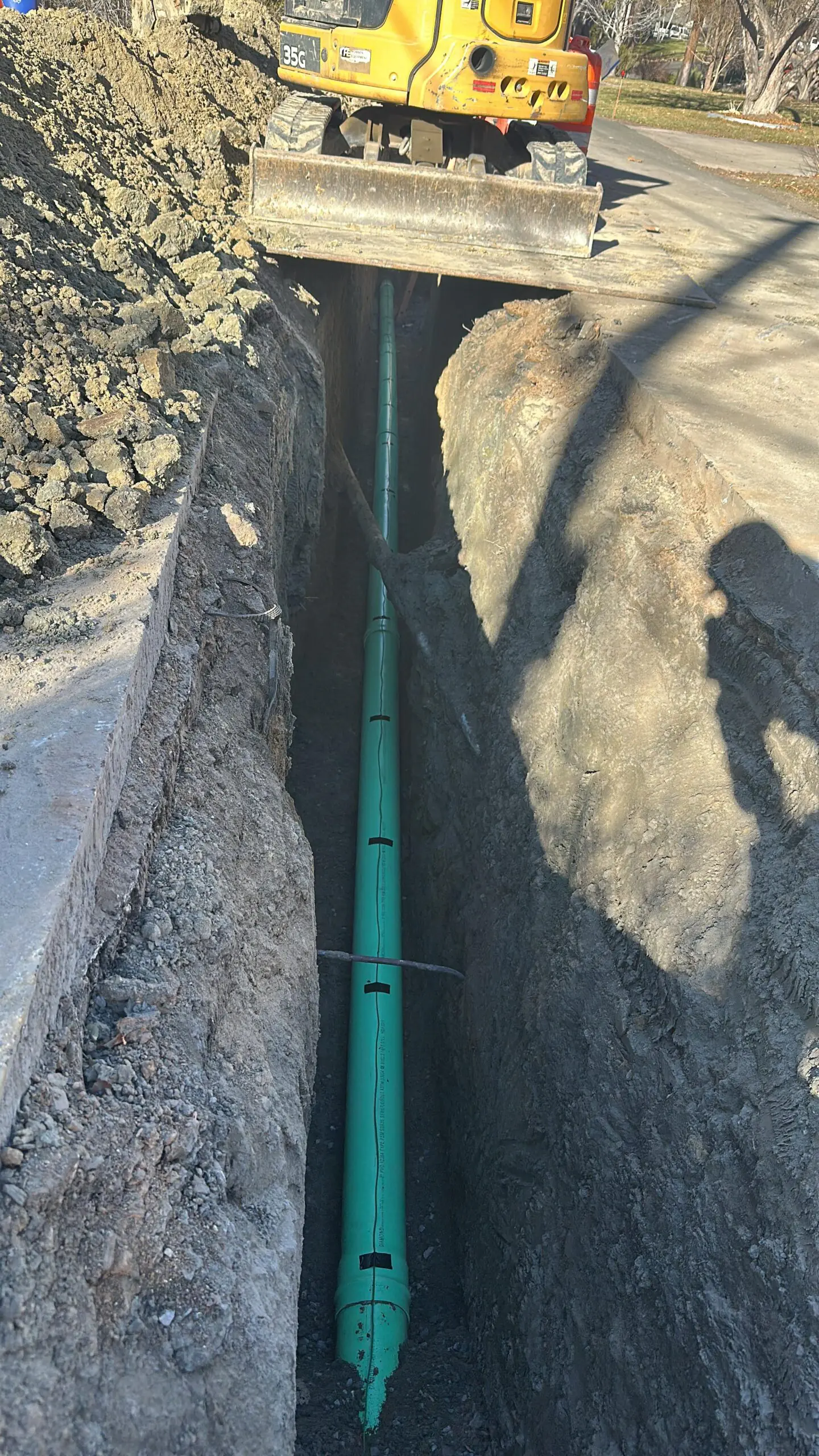
Sewer & Water Line Terms Explained
Sewer line glossary in plain English: lateral, tap, belly, offset joint, Orangeburg, pipe bursting and more. Understand your scope report before you decide.
Your sewer scope report or estimate is full of words like lateral, belly and wye. This sewer line glossary explains the sewer and water line terms homeowners see most, in plain English. Knowing them helps you understand what the camera found and why we recommend a certain fix.
Terms are grouped by topic. If something on your paperwork isn’t here, call us at 303-288-0039 and we’ll walk you through it.
What are the parts of a sewer line?
Sewer lateral
The private pipe that carries everything from your house to the public sewer main. It’s also called the service line or building sewer. Most of our sewer line repair and replacement work happens on the lateral.
Sewer main
The large public pipe under the street or alley that collects waste from every home on the block. The city or sanitation district owns and maintains it.
Tap
The connection point where your lateral joins the main. Taps fail often on older lines, and fixing one usually means digging in the street or alley. See our page on sewer tap repair.
Building drain
The section of sewer pipe inside or under your home, before it exits the foundation. In older homes it’s often cast iron buried under the basement slab.
Clean-out
A capped pipe that rises to ground level or a basement floor and gives direct access to the sewer line. It lets us run a camera, cable or jetter without pulling a toilet.
Double clean-out
Two clean-outs side by side, one pointing toward the house and one toward the street. Access in both directions makes future cleaning and inspection easier. We often add one during a repair; see spot repairs and clean-out installation.
Stub-out
A short piece of pipe left sticking out from a main, tap or foundation for a future connection. Your report may note an unused stub-out from an old fixture or addition.
Wye
A Y-shaped fitting that joins two pipes at an angle so the flows merge smoothly. Wyes are used where branch lines connect and at most clean-outs.
Slope (grade)
The downhill pitch of a sewer pipe. Too little slope lets waste sit in the line. Too much lets water run ahead and leave solids behind.
What sewer pipe materials will I see on a report?
Clay tile
Also called vitrified clay. Short ceramic sections joined every few feet, common in older Denver homes. The joints let roots in, and the pipe can crack or shift as soil moves.
Orangeburg
Pipe made of wood fiber soaked in tar, used mostly in the mid-1900s. It softens, blisters and flattens with age. If the camera finds Orangeburg, replacement is usually the only lasting fix.
Cast iron
Heavy metal pipe used for decades inside homes and under basement floors. It corrodes from the inside, building scale until it channels or cracks. See basement cast iron sewer repair.
ABS
Black plastic drain and sewer pipe. It’s light and resists roots, but glued joints can separate and the pipe can deform under heavy soil loads.
PVC (SDR 35)
White or green plastic pipe; SDR 35 is the common wall thickness for buried sewer laterals. It’s smooth inside, resists roots and has tight joints. It’s a standard material for new exterior sewer lines.
HDPE
High-density polyethylene, a tough and flexible plastic pipe. Sections are heat-fused into one continuous pipe with no joints for roots to enter. That’s why it’s the usual choice for pipe bursting.
What problems does a sewer camera find?
Sewer scope
A video inspection made by pushing a camera through the line, usually from a clean-out. It shows the pipe material, its condition and where problems sit. Ours costs $99; see sewer camera inspections.
Belly (sag)
A low spot where the pipe has settled and water collects. Paper and solids drop out there, so bellies cause repeat clogs. Shallow bellies can sometimes be watched; deep ones usually need repair.
Offset joint
Two pipe sections that have shifted out of line, leaving a lip inside. Solids catch on the edge, and the gap invites roots and leaks.
Root intrusion
Tree roots growing into the pipe through joints or cracks. They start as fine hairs and grow into thick mats that block flow and can break the pipe.
Scale
Hard, crusty buildup inside cast iron pipe caused by corrosion. It narrows the pipe and snags waste. Heavy scale often means the pipe wall is getting thin.
Channeling
A groove eaten along the bottom of cast iron pipe where water runs. Once the bottom wears through, waste leaks into the soil under your slab.
Crack or fracture
A split in the pipe wall from age, roots, soil movement or ground pressure. Small cracks tend to grow into breaks over time.
Collapse
A section that has caved in or broken apart, blocking or badly restricting flow. A collapse needs repair or replacement; cleaning can’t fix it.
Not sure what’s in your line? A camera shows you before you spend a dime on repairs.
What sewer line repair methods are there?
Open trench
Digging a trench along the pipe to remove and replace it. It’s the right call when the line has bellies, needs its slope corrected or must be rerouted. See excavation services.
Full replacement
Replacing the whole lateral, from the house to the main. Our full replacements carry a 20-year warranty that transfers to a new owner.
Pipe bursting
A trenchless method: a bursting head pulls new pipe through the old line, breaking the old pipe outward. It needs only a pit at each end instead of a full trench. Learn more about pipe bursting, which carries a 10-year warranty with us.
CIPP lining
Cured-in-place pipe: a resin-soaked liner is inflated inside the old pipe and hardened in place. Go Direct does not offer lining. We repair or replace with new pipe instead.
Spot repair
Digging up and replacing only the damaged section. It makes sense when the rest of the line is in good shape. Our spot repairs carry a 3–5 year warranty.
Hydro jetting
High-pressure water sprayed through the line to cut roots, grease and buildup off the pipe walls. See hydro jetting.
Snaking (augering)
A rotating cable with a cutting head pushed through the pipe to clear a clog. It opens the line quickly but doesn’t scrub the walls clean. See drain cleaning.
What do permits and the city side involve?
Permit
Approval from your city or county to do sewer or water line work. Requirements vary by city, and most replacement work needs one.
Inspection
The city inspector’s check of new pipe, connections and slope while the trench is still open. The job must pass before the pipe is buried.
Locate
Marking buried utilities before anyone digs. Colorado requires a call to 811 first, and utility companies then flag or paint gas, electric, water and cable lines.
Backfill and compaction
Refilling the trench and packing the soil down in layers. Good compaction keeps your lawn, driveway or the street from sinking over the new pipe later.
Street cut
Cutting through pavement to reach the main or tap. It usually adds permits, traffic control and patching, which is why street work costs more than yard work.
What water line terms should I know?
Water service line
The pipe that brings fresh water from the city main into your house. A leak here often shows up as a soggy spot in the yard or a jump in the water bill. See water line repair and replacement.
Curb stop
A shutoff valve on the water service, usually near the property line under a small metal cap. It shuts off water to the whole house.
Copper
Durable metal pipe used for water lines for decades. It lasts a long time but can develop pinhole leaks, especially as it ages.
Galvanized steel
Zinc-coated steel pipe found in many older homes. It rusts from the inside, which narrows the pipe and drops your water pressure.
PEX
Flexible plastic tubing used mostly for water lines inside the home. It bends around corners, so it needs fewer fittings.
Poly (polyethylene)
Flexible plastic pipe often used for buried water service lines. It comes in long coils, so a run has few joints. Older poly can turn brittle and crack.
Pressure test
Filling a line with pressure and watching the gauge for a drop. It proves new pipe is tight and helps confirm whether an old line is leaking.
Frost depth
How deep the ground freezes in winter. Water lines must be buried below it so they don’t freeze, and local code sets the minimum depth.
Questions about sewer line terms
Does Go Direct offer pipe lining (CIPP)?
No. We fix sewer lines with new pipe, either by open trench, pipe bursting or a spot repair. Our camera inspection shows which of those fits your line.
What’s the difference between a sewer lateral and a sewer main?
The lateral is the private pipe from your house to the street. The main is the public pipe that collects waste from the whole block. The tap is where the two connect.
How do I find out what my sewer pipe is made of?
A sewer scope shows it. The camera tells clay, cast iron, Orangeburg and plastic apart, and it shows where the material changes along the line.
Does a belly always mean I need a new sewer line?
Not always. A shallow belly that holds a little water may just need watching. A deep belly that catches waste and causes backups usually needs a spot repair or replacement.
Who is responsible for the sewer tap?
It depends on your city or sanitation district, and the rules aren’t the same everywhere. Ask before you assume the city will pay. We can explain what tap work involves when we look at your line.
Sewer or Water Line Problem? We Can Be There Today.
Slow drains, backups or a soggy spot in the yard usually point to a sewer or water line problem. Call for a free estimate or book online, with same-day camera inspections across the Denver metro area.